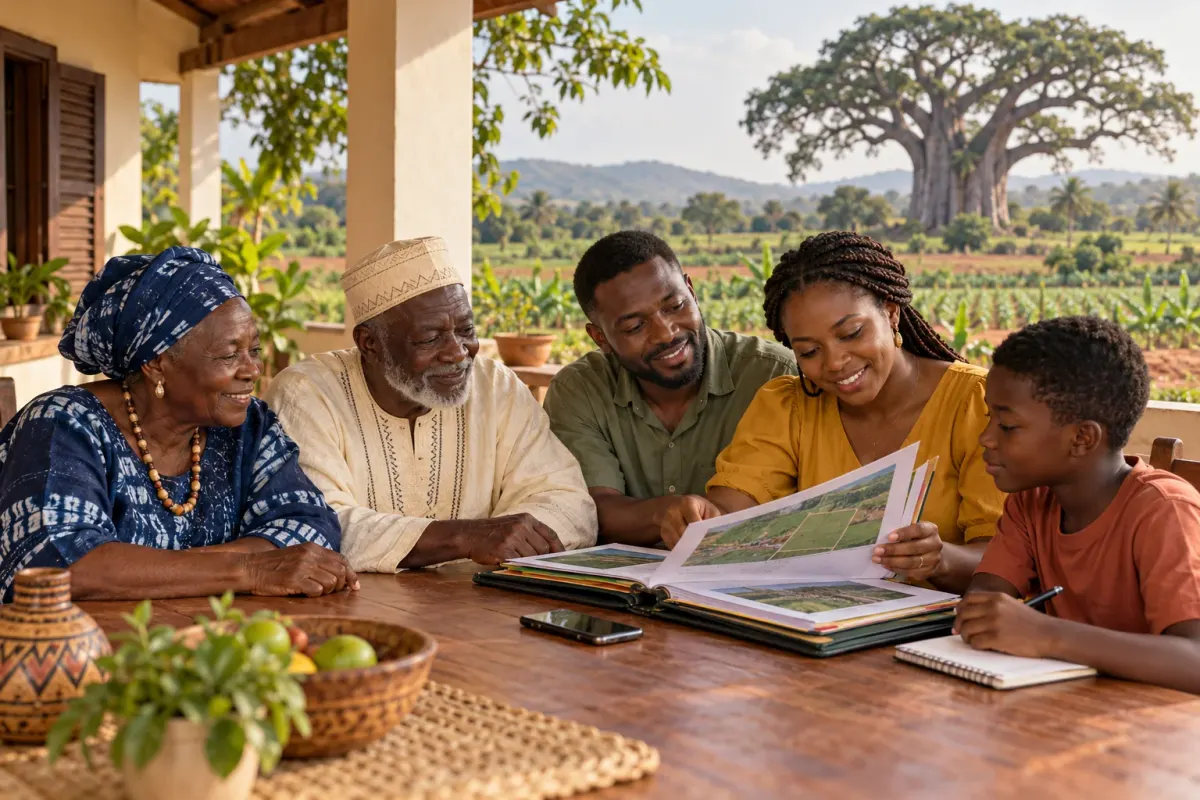
At Christmas, the Mensah family gathered in the hometown. After the meal, Adwoa set her phone on the table and pressed play.
Nana Akosua's voice filled the room, telling the story of the odum tree and the forest her grandfather first cleared. The children went quiet. Wofa Kwabena nodded along. Adwoa's young cousin Kwame, who was 12, asked, "Is that really you, Nana?"
Nana Akosua laughed. "That is me. And one day, it will be you telling it."
The Mensahs are a fictional family. Their story follows common situations that many Ghanaian families will recognise.
Why this matters
Over the past months, the Mensah family had written down their land's history, gathered their documents, had the farmland properly surveyed, started the appropriate registration process and organised digital copies.
But records are only useful if they are kept up to date. Agreements end and are renewed, payments are made, decisions are taken, and new generations arrive. Preparing land for the next generation means keeping all of this together, so that children and grandchildren don't have to start again from a brown envelope and fading memories.
The family land file
A family land file brings everything together in one organised place, on paper, digitally, or both. It might include:
- The history: notes and recordings of elders' stories, and how the family came to hold the land.
- The documents: originals kept safely, with copies.
- The plans: the site plan, and any sketches clearly labelled as sketches.
- Registration records: receipts, reference numbers and the current status.
- Land use: who uses which part of the land, and on what terms.
- Agreements: leases and other arrangements, with their start and end dates.
- Payments: money received or paid in connection with the land, with receipts.
- Decisions: important family decisions about the land, and when they were made.
- Useful contacts: for example, the surveyor who did the work and the office handling the registration.
Recording use, agreements and payments
Land use. Write down who farms or uses each part of the land, and on what understanding. In the Mensah file, a short note records that Mr Owusu farms the portion near the road, under a written agreement with the family.
Agreements. Keep each agreement with a short summary: who it is with, what it covers, how long it lasts and when it should be reviewed. Mr Owusu's agreement is due for renewal next year, and that date is now noted at the front of the file.
Payments. Record every payment: the date, the amount, who paid, who received it, and the receipt. Clear records help everyone trust the arrangement. Adwoa and her father filled in the years of Mr Owusu's payments that had been missing, using his own receipts to check.
Recording decisions
Families make important decisions about land: whether to lease a portion, whether to have the land surveyed, how to use income. Write down what was decided, when and by whom.
A simple note is enough:
Family meeting, December. Present: Wofa Kwabena, Nana Akosua, Kofi, Adwoa and others. Agreed: review Mr Owusu's agreement before renewal next year. Kofi to check on the registration application in March.
Decisions remain with those who have authority over the land. A good record simply makes sure they are remembered, and helps future generations understand why things are as they are.
Keeping the file alive
A file that nobody updates soon becomes out of date. A few simple habits help:
- Choose a regular time to review it, such as once a year at a family gathering.
- Update it when something changes: a new agreement, a payment, a decision, a step in the registration process.
- Agree who looks after it, and who else can see it.
- Keep the backups current.
Not everything will be finished at once. For the Mensahs, the registration application was still in progress. That is normal. The file records where things stand, and it is updated as things move forward.
Passing on the knowledge
The file is not only about papers. It is also about people.
Encourage elders to keep sharing their stories, and invite younger relatives to listen, help and learn where the file is kept. Questions about inheritance and succession are important too, but they need proper advice of their own; this series doesn't cover them.
That Christmas, Kwame asked if he could help Adwoa next year. She handed him the notebook. "Start by listening to Nana," she said. "Then write down what you learn."
Your invitation
You don't need to do everything at once. You only need to begin.
- This week: ask a parent or elder one question about your family's land.
- This month: with permission, list the land documents your family already has and photograph them carefully.
- This year: help your family bring the history, documents and records together in one safe, organised place.
You are not the one who decides. But you can help your family learn, organise and remember, and that matters a great deal.
A question to raise at home
- "What would we want our grandchildren to know about our land?"
The end of the series, and the beginning of your family's story
Your family's land has a history. Help your parents document it, organise it, and prepare it for the next generation.
If this is your first article, start the series from the beginning with Our Land Has a Story.