The sun was already low when Adwoa Mensah followed her father along the narrow path to the family farm. Cassava stood tall on one side. On the other, the old cocoa trees leaned towards the stream.
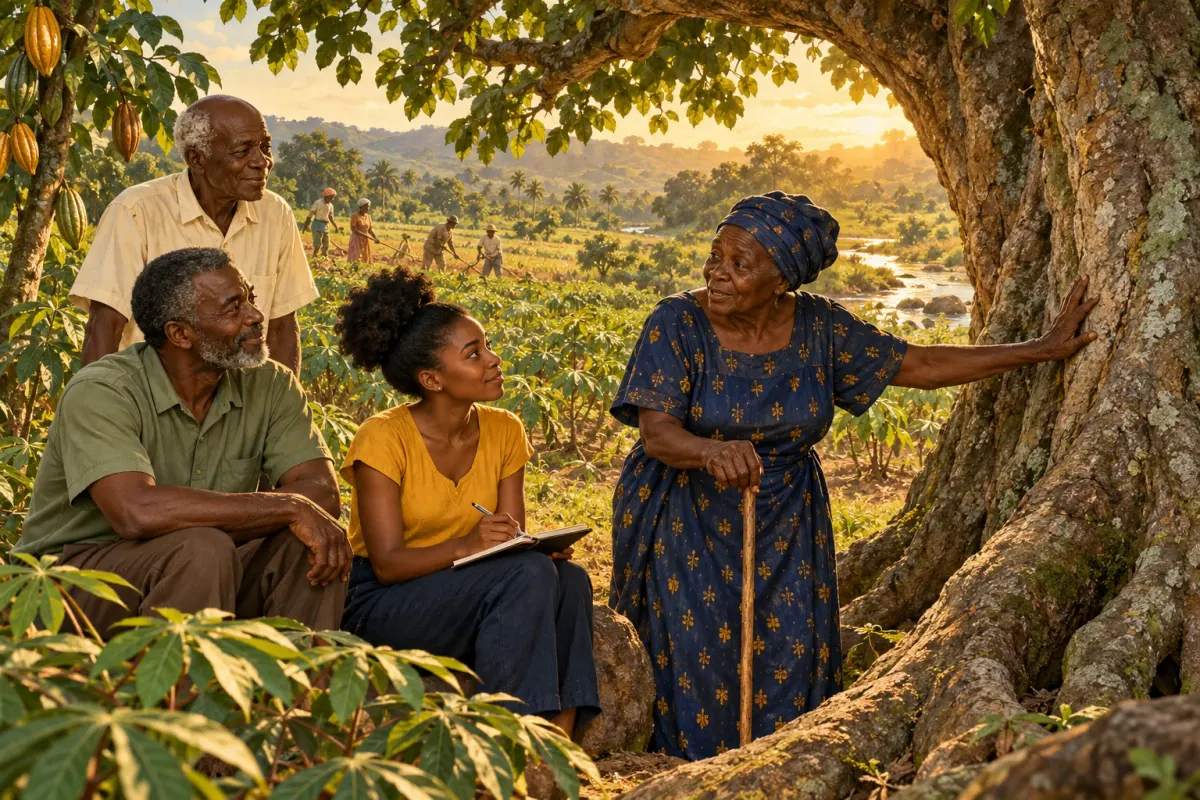
Her grandmother, Nana Akosua, was waiting under the big odum tree at the edge of the land. She tapped its trunk with her walking stick.
"Your great-great-grandfather planted his first crops beside this tree," she said. "When he came here, there was nothing but forest."
Adwoa was 19. She had walked this path many times, but she had never heard that story. As her grandmother kept talking about who farmed which part, the year the stream flooded and the old disagreement with a neighbour, Adwoa realised something. Almost none of it was written down anywhere.
The Mensahs are a fictional family. Their story follows common situations that many Ghanaian families will recognise.
Land is more than soil
For many families in Ghana, land is not just property. It is where grandparents are remembered, where food is grown, and where the family's name is known. It connects people living in the hometown with relatives in Accra, Kumasi or abroad.
Family land often holds three kinds of value at once:
- History: how the family came to hold the land, who first farmed it, and how it has passed down the generations.
- Identity: a sense of belonging. Knowing where your family comes from, and having a place to return to.
- Livelihood: the farm that feeds the household, the crops that pay school fees, the plot where a house may one day stand.
That is why land matters so deeply to parents and elders. When they talk about it, they are often talking about their own parents, their struggles and their hopes for you.
Where the knowledge lives
In many families, the most important information about the land has never been written down. It lives in memory.
Your grandmother may know where the old boundary marks were. Your father may remember which relative farmed the far corner, or what was agreed with a neighbour years ago. An elder may know how the family first came to hold the land at all.
This knowledge is valuable, and it can disappear. People grow old. Relatives move away. Details blur over time. When the person who remembers is no longer here, the family may be left with questions nobody can answer.
Why writing it down matters
Families who keep a clear record of their land's history are usually better prepared for what comes next. A good record can:
- Reduce confusion about where the land lies, how it is used and who has a say.
- Preserve memories that would otherwise be lost.
- Make the next steps easier, such as gathering documents, having the land properly surveyed and registering it in the appropriate way.
- Build confidence. Clear, legitimate records help the family understand its own land. They can also reassure others, such as a tenant farmer, a buyer or a bank, if the family ever decides to lease or sell. Good records can make land easier to deal with, though no record can promise a price, a buyer or a loan.
Writing down the story does not create ownership, and it does not replace official documents. It is the starting point that makes everything else in this series easier.
Your role in your family's story
You may not be the one who makes decisions about the land. Those decisions rest with your parents and the family members who hold that responsibility. But you can play a valuable part.
Young people often bring skills that complement what elders know. You may be comfortable with a phone, good at taking notes, and patient enough to organise information. Your parents and elders bring the memory, the experience and the authority. Together, the family has what it needs.
You can help by:
- Showing interest. Ask about the land, and listen properly when elders talk about it.
- Noticing what is missing. Do you know where your family's land is? How it came to the family? Who looks after it today?
- Offering to help. Let your parents know you would like to help record what they know, when they are ready.
Questions to think about at home
- "How did our family come to have this land?"
- "Who in our family knows the most about its history?"
You don't need all the answers today. Simply asking shows your family that you care about what they have protected for so long.
What comes next
Adwoa went home that evening with a question: how could she ask her family about the land without seeming rude or too forward?
In the next article, Ask Before It's Forgotten, we look at how to start that conversation respectfully: whom to approach, what to ask, and how to record what you learn.