Kofi Mensah took a brown envelope down from the top of the wardrobe. Its corners were soft with age, and someone had written "LAND" across the front in blue ink.
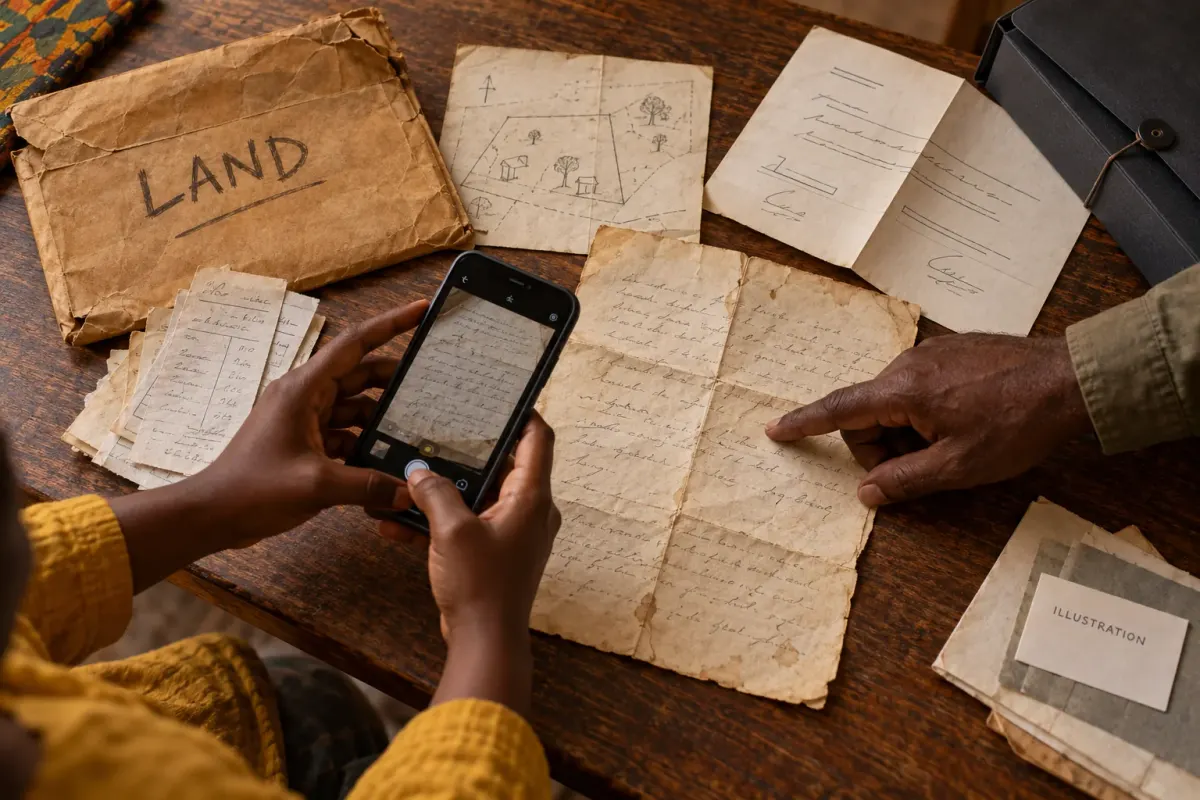
He tipped it out onto the table. A folded letter. A few faded receipts. A hand-drawn sketch. A typed page with signatures at the bottom.
"This is everything?" Adwoa asked.
"Everything I have," her father said. "Some of it may be with Wofa Kwabena."
The Mensahs are a fictional family. Their story follows common situations that many Ghanaian families will recognise.
Why the papers matter
Many families keep land papers in an envelope, a metal box or a suitcase under the bed. Knowing what your family already holds shows what exists, what is missing, and what may be needed before steps such as surveying or registration. It also helps protect the papers. A document that is lost, eaten by termites or damaged by water can be difficult, and sometimes impossible, to replace.
Where documents may be
Always ask your parents' permission before looking through anything. Papers may be in more than one place, for example with:
- Your parents.
- The family head or another elder.
- A relative who handled a past transaction.
- A lawyer or surveyor the family used before.
- Someone who farms or rents part of the land.
Documents families often keep
Every family is different, but these are some of the documents you may come across:
- Letters or notes recording a family meeting, a gift of land or an agreement.
- Agreements or leases, written arrangements allowing someone to use the land, often for a period of time and a payment.
- An indenture, a formal written document recording a grant or transfer of an interest in land.
- A site plan, a drawing showing the land's position, shape and measurements.
- Receipts for payments, such as rent, fees or past transactions.
- Official papers, for example from the Lands Commission, a court or a district assembly.
Not every family will have all of these, and many families hold land legitimately with very few papers at all.
What a document shows, and what it doesn't
This is one of the most important ideas in this series: a document is evidence, not a guarantee.
A document can show that an agreement was made, a payment was received, or a plan was drawn. But simply holding a document does not automatically prove that someone owns the land, or that the document is complete and valid.
For example:
- A receipt shows that money was paid. It may not show exactly what the payment was for.
- A sketch helps describe the land. It is not a professional survey.
- An agreement is more reliable when it clearly names the parties, describes the land, is signed and witnessed, and was made by people with the authority to make it.
Official processes have their own requirements. The Lands Commission, for example, lists what documents must show before they can be registered, such as the names and signatures of the parties and an approved site plan with matching details.
So ask simple questions of each paper. What is it? What does it describe? Who signed it? Is anything unclear?
Notice what is missing
Adwoa and her father laid out every paper and listed them one by one:
- A 1987 letter recording a family meeting about the farm.
- A signed agreement between Wofa Kwabena, as family head, and Mr Owusu, who farms a portion near the road.
- Receipts for Mr Owusu's yearly payments, though several years were missing.
- Nana Akosua's hand-drawn sketch of the land, showing the odum tree and the stream.
Then they noticed what wasn't there. There was no site plan for the farmland, and nothing showed that the land had ever been registered.
A simple list of what you have and what seems to be missing tells the family where to look next, and what to ask a professional or the relevant authority when the time comes.
Keep the originals safe
Once you know what you have, protect it.
- Make copies or clear photographs, with permission. Photograph each page flat, in good light, with every edge visible.
- Keep the originals in one safe place, away from water, heat and termites. A sealed plastic folder inside a closed box is far better than a loose envelope.
- Avoid carrying originals around. Take a copy unless an original is specifically required. Some official processes require originals or certified copies, so keep originals in good condition.
- Agree who keeps what. The family should know where every original is, and who holds it.
- Keep land documents private. Never post them on social media or share them in group chats.
How you can help
- Offer to list the documents with your parents.
- Photograph each document carefully, with permission.
- Write down questions about anything unclear, for your parents or elders to answer.
Questions to raise at home
- "Do we know where all our land documents are kept?"
- "Is there anything important about our land that has never been put on paper?"
What comes next
Looking at Nana Akosua's sketch, Adwoa asked: "But where exactly does our land end?" Nobody at the table could answer with confidence.
In the next article, Where Exactly Does Our Land End?, we look at boundaries, surveying and why a proper site plan matters.